Introduction
Artificial intelligence has evolved from an emerging technology into an essential part of modern work and everyday life. Whether you’re drafting emails, writing articles, analyzing reports, generating software code, brainstorming business ideas, or conducting research, AI assistants are helping millions of people complete tasks faster and more efficiently.
Among the growing number of AI-powered platforms available today, two names consistently dominate the conversation: ChatGPT and Claude.
Both are powered by advanced large language models capable of understanding natural language, answering complex questions, generating creative content, assisting with programming, summarizing lengthy documents, and supporting a wide range of professional workflows. At first glance, they appear remarkably similar, which often leads users to ask an important question:
Which AI assistant is actually better?
The answer isn’t as straightforward as many people expect.
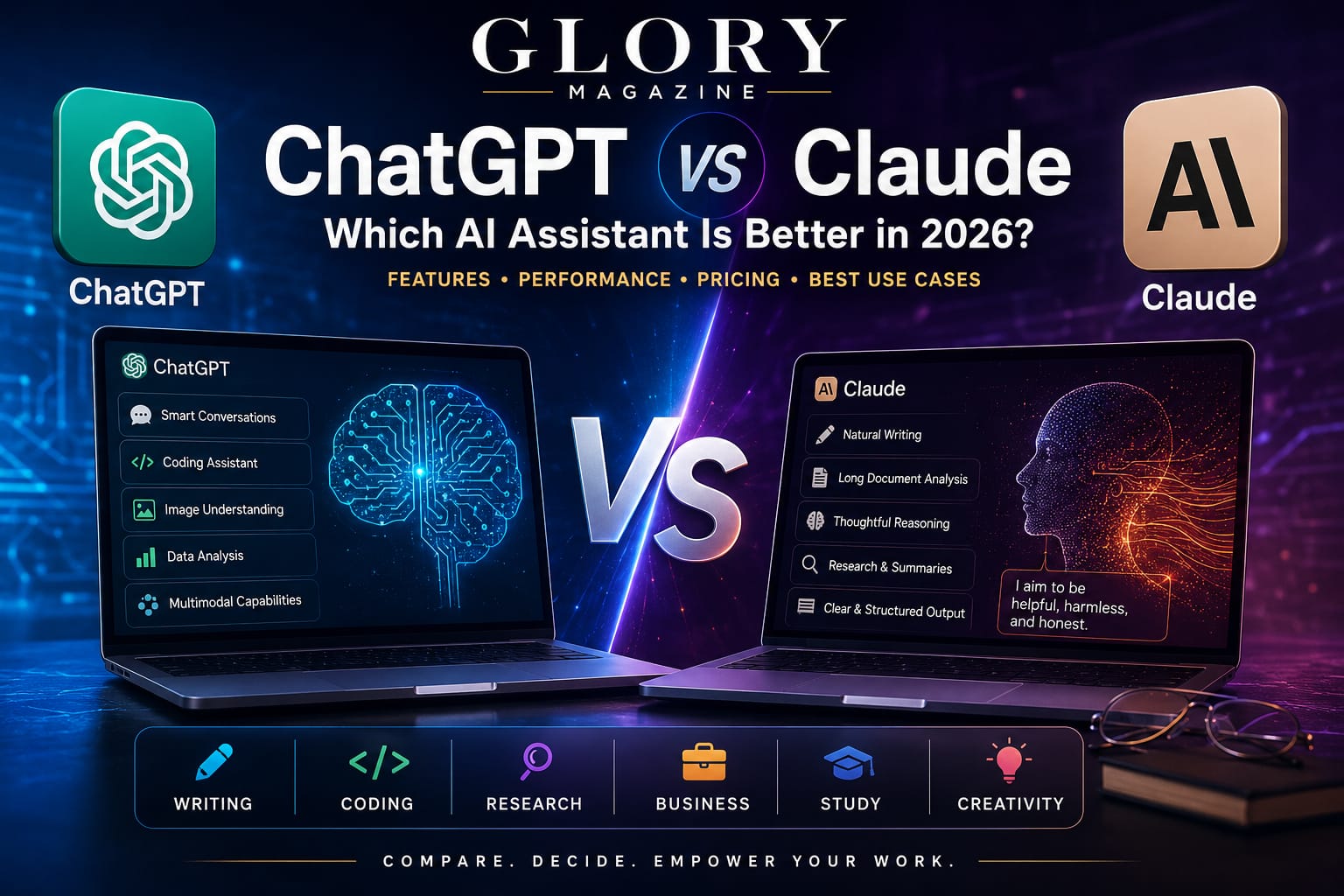
Although ChatGPT and Claude share many capabilities, each has developed its own strengths over time. ChatGPT is widely recognized for its versatility, extensive ecosystem, multimodal capabilities, and broad adoption across industries. Claude, on the other hand, has earned praise for its natural writing style, thoughtful reasoning, and ability to work effectively with lengthy documents and detailed analysis.
Choosing between them depends less on which platform is “best” overall and more on how you intend to use artificial intelligence in your daily work. A software developer may prioritize coding assistance and debugging capabilities, while a content writer may care more about writing quality and tone. Business professionals might focus on productivity and workflow integration, whereas students often value research support and ease of use.
In this comprehensive comparison, we’ll examine both AI assistants across the areas that matter most, including writing quality, creativity, coding performance, reasoning, document analysis, research capabilities, pricing, user experience, business applications, and overall value.
Rather than relying on marketing claims or popularity alone, this guide focuses on practical strengths, limitations, and real-world use cases to help you make an informed decision.
Whether you’re considering your first AI subscription or thinking about switching platforms, this article will help you understand which assistant is the better fit for your personal or professional needs.
Quick Verdict
If you don’t have time to read the full comparison, here’s a brief overview.
| Category | Winner |
|---|---|
| Best Overall AI Assistant | 🏆 ChatGPT |
| Best for Long-Form Writing | 🏆 Claude |
| Best for Coding | 🏆 ChatGPT |
| Best for Research | 🏆 Claude |
| Best for Creativity | 🤝 Tie |
| Best for Business Productivity | 🏆 ChatGPT |
| Best for Students | 🏆 ChatGPT |
| Best for Large Documents | 🏆 Claude |
| Best Multimodal Experience | 🏆 ChatGPT |
| Best Overall Value | 🏆 ChatGPT |
While ChatGPT takes the overall lead due to its versatility and broader ecosystem, Claude remains an exceptional choice for writers, researchers, analysts, and professionals who frequently work with detailed documents. As we’ll see throughout this comparison, the “better” assistant ultimately depends on the tasks you perform most often.
ChatGPT vs Claude at a Glance
| Feature | ChatGPT | Claude |
|---|---|---|
| Developer | OpenAI | Anthropic |
| Primary Strength | Versatility and broad capabilities | Long-form writing and thoughtful analysis |
| Writing Quality | ⭐⭐⭐⭐⭐ | ⭐⭐⭐⭐⭐ |
| Coding Assistance | ⭐⭐⭐⭐⭐ | ⭐⭐⭐⭐☆ |
| Creative Content | ⭐⭐⭐⭐⭐ | ⭐⭐⭐⭐⭐ |
| Document Analysis | ⭐⭐⭐⭐☆ | ⭐⭐⭐⭐⭐ |
| Research Support | ⭐⭐⭐⭐☆ | ⭐⭐⭐⭐⭐ |
| Ease of Use | ⭐⭐⭐⭐⭐ | ⭐⭐⭐⭐⭐ |
| Business Productivity | ⭐⭐⭐⭐⭐ | ⭐⭐⭐⭐☆ |
| Image Understanding | ⭐⭐⭐⭐⭐ | ⭐⭐⭐☆☆ |
| Overall Rating | ⭐⭐⭐⭐⭐ | ⭐⭐⭐⭐☆ |
Editor’s Note: AI models evolve rapidly through frequent updates. This comparison reflects the capabilities of ChatGPT and Claude as available in 2026. Features, pricing, and performance may change over time, so it’s always worth checking the latest updates before making a long-term decision.
What We’ll Cover
In the sections ahead, we’ll answer some of the most common questions readers have, including:
- What makes ChatGPT different from Claude?
- Which AI writes better?
- Which one is more accurate?
- Which assistant is better for coding?
- Which platform offers better value for money?
- Which AI is more suitable for students and professionals?
- Which one should you subscribe to in 2026?
We’ll also compare the two platforms across real-world scenarios so you can choose the AI assistant that best matches your workflow instead of relying solely on feature lists or online opinions.
Understanding ChatGPT and Claude
Before comparing ChatGPT and Claude feature by feature, it’s important to understand what each platform was designed to do. Although both are conversational AI assistants built using advanced large language models (LLMs), they have evolved with slightly different philosophies and strengths.
Understanding these differences makes it much easier to choose the assistant that best fits your workflow.
What is ChatGPT?
Overview
ChatGPT is an AI assistant developed by OpenAI and has become one of the most recognized artificial intelligence platforms in the world. Since its public launch, it has transformed how millions of people write, learn, code, research, brainstorm ideas, and solve everyday problems.
Today, ChatGPT is used by individuals, startups, Fortune 500 companies, educational institutions, and software development teams across a wide range of industries.
Rather than being limited to answering questions, ChatGPT has evolved into a comprehensive AI productivity platform capable of assisting with almost every type of knowledge work.
Whether you’re drafting a business proposal, debugging software, planning a marketing campaign, summarizing research papers, analyzing spreadsheets, or generating creative ideas, ChatGPT aims to become a versatile digital assistant that adapts to your needs.
Key Features of ChatGPT
One of ChatGPT’s biggest strengths is the variety of tasks it can perform.
Some of its most popular capabilities include:
- Writing blog articles
- Email drafting
- Coding assistance
- Debugging software
- Business planning
- Brainstorming ideas
- Language translation
- Document summarization
- Data analysis
- Image understanding
- Presentation preparation
- Learning new subjects
- Resume writing
- Interview preparation
- Marketing content creation
Unlike specialized AI tools that focus on only one task, ChatGPT attempts to be useful across almost every profession.
Where ChatGPT Excels
1. Versatility
If there is one word that best describes ChatGPT, it is versatility.
Instead of being built for only writers or developers, ChatGPT performs well across dozens of different industries.
For example:
A student can use it for homework.
A programmer can generate code.
A lawyer can summarize contracts.
A marketer can write advertising copy.
A teacher can prepare lesson plans.
A business owner can create sales strategies.
Very few AI assistants perform consistently across such a wide range of tasks.
2. Excellent Coding Support
Developers frequently choose ChatGPT because of its programming capabilities.
It supports numerous programming languages including:
- Python
- JavaScript
- Java
- C++
- C#
- PHP
- Go
- Rust
- Kotlin
- Swift
- SQL
Beyond generating code, it can explain complex concepts, identify bugs, optimize existing code, suggest alternative approaches, and assist with software architecture.
For both beginners and experienced developers, this significantly reduces development time.
3. Multimodal Capabilities
Modern versions of ChatGPT go beyond plain text.
Depending on the plan and features available, users can interact using:
- Text
- Images
- Documents
- Voice
- Charts
- PDFs
This flexibility makes ChatGPT useful for tasks such as analyzing screenshots, interpreting diagrams, reviewing reports, extracting information from uploaded files, and assisting with visual content.
4. Large Ecosystem
Another major advantage is the growing ecosystem surrounding ChatGPT.
It integrates with numerous workflows and continues to expand through new features and third-party connections.
For many users, ChatGPT becomes the central AI assistant they rely on throughout the day rather than just another application.
Limitations of ChatGPT
Despite its strengths, ChatGPT is not perfect.
Some limitations include:
- Responses may occasionally contain factual errors.
- Highly specialized industries may still require human expertise.
- Some advanced features are available only through paid plans.
- Users should verify important legal, financial, or medical information before relying on AI-generated responses.
These limitations are not unique to ChatGPT but are common across most generative AI systems.
Who Should Choose ChatGPT?
ChatGPT is particularly well suited for:
- Students
- Software developers
- Entrepreneurs
- Content creators
- Digital marketers
- Business professionals
- Researchers
- Teachers
- Freelancers
- Consultants
If you need one AI assistant capable of handling many different types of work, ChatGPT is an excellent choice.
What is Claude?
Overview
Claude is an AI assistant developed by Anthropic, a company focused on building reliable, safe, and helpful artificial intelligence systems.
Although Claude entered the market later than some competitors, it quickly gained recognition for producing thoughtful, well-structured responses and maintaining context exceptionally well during long conversations.
Instead of trying to impress users with flashy features, Claude focuses on delivering clear reasoning, natural writing, and strong comprehension of lengthy documents.
For professionals who regularly work with reports, contracts, academic papers, research documents, policy manuals, or technical documentation, Claude has become one of the most respected AI assistants available today.
Key Features of Claude
Claude offers a broad range of capabilities, including:
- Long-form writing
- Research assistance
- Document analysis
- Business writing
- Report summarization
- Brainstorming
- Coding assistance
- Translation
- Data interpretation
- Strategic planning
- Educational support
Although its feature list appears similar to ChatGPT’s, many users appreciate Claude’s distinctive writing style and analytical approach.
Where Claude Excels
1. Natural Writing Style
One of Claude’s biggest strengths is producing writing that feels natural and coherent.
Instead of generating overly formal or repetitive text, Claude often creates content with a smooth flow and consistent tone.
This makes it particularly popular among:
- Authors
- Journalists
- Editors
- Researchers
- Bloggers
- Business consultants
For long-form content, many professionals find Claude’s writing requires less editing before publication.
2. Handling Large Documents
Claude performs especially well when working with extensive documents.
Examples include:
- Research papers
- Legal contracts
- Company policies
- Financial reports
- Technical manuals
- Academic articles
It can summarize lengthy material, identify key points, answer questions based on the document, and explain complex sections in simpler language.
Professionals dealing with large volumes of text often consider this one of Claude’s greatest strengths.
3. Thoughtful Reasoning
Claude is frequently praised for its careful reasoning.
Rather than immediately jumping to conclusions, it often explains its thinking step by step, making its responses easier to understand and evaluate.
This characteristic makes Claude particularly valuable for:
- Business analysis
- Strategic planning
- Research discussions
- Educational explanations
- Complex decision-making
4. Consistent Long Conversations
Maintaining context over extended discussions is another area where Claude performs well.
When conversations become lengthy or involve multiple interconnected topics, Claude often maintains coherence effectively, helping users avoid repeating background information.
This is especially useful for writers developing books, researchers exploring a topic over several sessions, and consultants working through detailed client projects.
Limitations of Claude
Like every AI assistant, Claude also has some limitations.
Examples include:
- Fewer ecosystem integrations than some competitors.
- More limited multimodal capabilities depending on the available version.
- Some advanced features require a paid subscription.
- Performance may vary depending on the complexity and specificity of the task.
These limitations are relatively minor for users whose primary focus is writing, reasoning, and document analysis.
Who Should Choose Claude?
Claude is particularly suitable for:
- Writers
- Editors
- Researchers
- Lawyers
- Consultants
- Analysts
- Students
- Educators
- Policy professionals
- Business strategists
If your work revolves around reading, writing, analyzing, and explaining information, Claude is one of the strongest AI assistants available today.
Initial Comparison
At this point, one important difference is already becoming clear.
ChatGPT aims to be an all-purpose AI assistant capable of supporting nearly every type of digital work—from coding and creative writing to image analysis and productivity.
Claude, meanwhile, places greater emphasis on thoughtful communication, long-form writing, and deep document understanding.
Neither philosophy is inherently better. The right choice depends on what you expect from an AI assistant.
In the next section, we’ll move beyond general descriptions and compare ChatGPT and Claude head-to-head across the areas that matter most, including writing quality, creativity, coding, research, reasoning, speed, pricing, user experience, and overall value.
Head-to-Head Comparison: ChatGPT vs Claude
Now that we’ve explored what ChatGPT and Claude are designed to do, it’s time for the real comparison.
Instead of declaring a single winner based on popularity, we’ll compare both AI assistants across the tasks people perform every day—from writing and coding to research, creativity, reasoning, and handling complex documents.
Keep in mind that no AI assistant is perfect for every scenario. The best choice depends on your goals, workflow, and the type of work you do most often.
1. Writing Quality
Writing is one of the primary reasons people use AI assistants. Whether you’re creating blog posts, business reports, emails, product descriptions, or social media content, the quality of the generated text matters.
ChatGPT
ChatGPT produces polished, engaging, and versatile content. It can quickly adapt to different writing styles, whether you need a formal business proposal, a casual blog post, persuasive marketing copy, or a creative story.
It also responds well to detailed instructions. If you ask it to write in a particular tone, follow a specific structure, or target a certain audience, it generally follows those instructions accurately.
This flexibility makes ChatGPT an excellent choice for marketers, entrepreneurs, teachers, students, and content creators who frequently switch between different writing tasks.
Claude
Claude has earned a strong reputation for producing writing that feels remarkably natural. Its responses often flow smoothly from one idea to the next, making them feel less mechanical and more like they were written by an experienced human author.
For long-form articles, reports, essays, and research summaries, Claude tends to maintain consistency exceptionally well. Many writers also appreciate that Claude often requires fewer edits before publication.
Where Claude truly shines is in thoughtful explanations. Instead of simply providing information, it often organizes ideas in a logical and easy-to-follow manner.
Winner
🏆 Claude
Why?
Both platforms produce excellent content, but Claude has a slight advantage when the goal is producing polished long-form writing with a natural flow. ChatGPT remains an outstanding writer, especially for marketing content and diverse writing styles, but Claude’s consistency over extended documents gives it a narrow lead in this category.
2. Creativity
Creativity is about much more than writing fiction. Businesses use AI for advertising campaigns, product names, branding ideas, storytelling, marketing strategies, video concepts, and brainstorming sessions.
ChatGPT
ChatGPT excels at generating a large variety of ideas very quickly.
Need:
- 50 business names?
- 20 YouTube video ideas?
- Marketing slogans?
- Startup concepts?
- Book titles?
- Product descriptions?
ChatGPT responds with speed and variety, making it an excellent brainstorming partner.
It also adapts well to different creative styles, whether you’re aiming for humorous, professional, inspirational, or technical content.
Claude
Claude approaches creativity somewhat differently.
Instead of generating dozens of ideas rapidly, it often focuses on producing more detailed, thoughtful, and coherent responses.
For storytelling, creative essays, or strategic brainstorming, Claude frequently delivers deeper and more structured suggestions.
Some users prefer this approach because it emphasizes quality over quantity.
Winner
🤝 Tie
Why?
Both platforms are highly creative, but they excel in different ways.
- Choose ChatGPT if you want many creative ideas quickly.
- Choose Claude if you prefer deeper exploration of fewer ideas.
For most users, both perform exceptionally well.
3. Coding Assistance
Programming has become one of the most popular AI use cases.
Developers now rely on AI to:
- Generate code
- Debug errors
- Explain algorithms
- Optimize performance
- Write documentation
- Learn new programming languages
ChatGPT
ChatGPT is widely used by software developers because it supports a broad range of programming languages and development tasks.
It performs well in:
- Python
- Java
- JavaScript
- TypeScript
- C++
- C#
- PHP
- Kotlin
- Swift
- SQL
- Go
- Rust
Beyond generating code, ChatGPT can explain why a bug occurs, suggest alternative implementations, optimize algorithms, and even assist with software architecture discussions.
Its conversational style also makes it particularly useful for beginners learning programming concepts.
Claude
Claude also provides strong coding assistance and can generate clean, readable code across many popular programming languages.
It performs especially well when reviewing existing code, explaining complex logic, or helping developers understand unfamiliar codebases.
However, many developers report that ChatGPT offers a broader range of coding examples and feels more mature for day-to-day software development.
Winner
🏆 ChatGPT
Why?
While Claude is certainly capable, ChatGPT has become the preferred AI assistant for many developers due to its versatility, strong programming knowledge, and consistent support across a wide range of coding tasks.
4. Research & Information Gathering
Students, analysts, journalists, consultants, and business professionals often rely on AI to accelerate research.
The ideal AI assistant should summarize information clearly, organize complex topics logically, and help users understand unfamiliar subjects.
ChatGPT
ChatGPT explains concepts in a simple, approachable way.
It excels at:
- Breaking down difficult topics
- Summarizing information
- Creating study notes
- Generating outlines
- Answering follow-up questions
Its conversational style makes learning interactive and engaging.
Claude
Claude’s analytical approach makes it particularly effective for research.
Its responses are often:
- More structured
- More detailed
- Better organized
- Easier to follow
Researchers working with complex topics frequently appreciate Claude’s ability to maintain logical consistency across lengthy discussions.
Winner
🏆 Claude
Why?
Claude’s structured reasoning and document analysis capabilities make it slightly better suited for in-depth research and analytical work.
5. Reasoning & Problem Solving
Modern AI assistants do much more than answer factual questions. They help solve business problems, evaluate strategies, analyze situations, and work through complex decisions.
ChatGPT
ChatGPT approaches problem-solving in a practical and conversational way.
It performs well when:
- Planning projects
- Brainstorming business ideas
- Solving programming challenges
- Explaining technical concepts
- Creating implementation plans
Its responses are usually direct and action-oriented.
Claude
Claude often spends more time developing a structured argument before reaching a conclusion.
Rather than immediately offering an answer, it tends to examine multiple perspectives, identify assumptions, and explain its reasoning in greater detail.
This approach is particularly valuable for consultants, analysts, educators, and researchers.
Winner
🏆 Claude
Why?
Claude’s careful reasoning process gives it a slight advantage for analytical thinking and complex discussions, although the gap between the two platforms continues to narrow.
6. Handling Large Documents
Many professionals work with lengthy documents every day.
Examples include:
- Research papers
- Contracts
- Financial reports
- Policy manuals
- Technical documentation
- Academic journals
ChatGPT
ChatGPT can summarize and analyze large documents effectively, identify important sections, and answer questions about uploaded content.
It performs well for most everyday document-related tasks.
Claude
Large document analysis has become one of Claude’s defining strengths.
Many professionals choose Claude specifically because it maintains context well across lengthy material and produces clear, organized summaries without losing important details.
This makes it particularly valuable in legal, academic, consulting, and research environments.
Winner
🏆 Claude
Why?
When working with extensive documents, Claude consistently demonstrates excellent context retention and coherent analysis, making it a preferred choice for document-heavy workflows.
Scorecard So Far
| Category | Winner |
|---|---|
| Writing Quality | 🏆 Claude |
| Creativity | 🤝 Tie |
| Coding | 🏆 ChatGPT |
| Research | 🏆 Claude |
| Reasoning | 🏆 Claude |
| Large Documents | 🏆 Claude |
At this stage, Claude leads in writing, research, reasoning, and document analysis, while ChatGPT remains the stronger choice for coding. Creativity is effectively a draw, with each platform offering distinct strengths.
However, several important categories remain—including business productivity, multimodal capabilities, user experience, pricing, ecosystem, speed, and overall value. These factors often influence real-world purchasing decisions just as much as writing or coding performance.
In the next section, we’ll examine these practical considerations before delivering our final verdict.
Practical Comparison: Business, Pricing & Everyday Use
While writing quality and reasoning are important, they aren’t the only factors that determine which AI assistant is right for you.
For many users, the real deciding factors are how well an AI integrates into their daily workflow, how easy it is to use, whether it offers good value for money, and how much time it actually saves.
Let’s compare ChatGPT and Claude from a practical perspective.
7. Business Productivity
Businesses increasingly rely on AI to automate repetitive tasks, generate reports, draft emails, create presentations, analyze data, and improve collaboration.
An AI assistant that can adapt to multiple business functions often provides greater long-term value.
ChatGPT
ChatGPT has become a versatile productivity tool for professionals across industries. It can help with:
- Writing business proposals
- Creating marketing campaigns
- Preparing presentations
- Drafting contracts and policies
- Generating reports
- Brainstorming products
- Summarizing meetings
- Analyzing spreadsheets
- Planning projects
- Creating training materials
Because it supports a wide variety of tasks within a single interface, many organizations use ChatGPT as a central AI assistant rather than maintaining multiple specialized tools.
Claude
Claude is particularly strong in business environments where employees regularly work with lengthy reports, policy documents, strategic plans, or research material.
Consultants, analysts, legal professionals, and executives often appreciate Claude’s ability to organize complex information into clear summaries and well-structured recommendations.
However, for organizations looking for one AI assistant to handle a broad range of business activities, ChatGPT generally offers more flexibility.
Winner
🏆 ChatGPT
Why?
Claude excels at document-heavy workflows, but ChatGPT’s broader capabilities make it a better all-around productivity assistant for most businesses.
8. Multimodal Capabilities
Modern AI is no longer limited to text. Users increasingly expect an assistant to understand images, documents, voice input, and other forms of content.
ChatGPT
ChatGPT offers one of the most comprehensive multimodal experiences available today.
Depending on your subscription and supported features, you can:
- Upload images for analysis
- Ask questions about charts and graphs
- Review screenshots
- Work with PDF documents
- Interact using voice
- Generate images
- Analyze visual content
This flexibility makes ChatGPT useful for designers, educators, engineers, marketers, and business professionals alike.
Claude
Claude also supports document analysis and visual understanding in supported versions, making it capable of interpreting uploaded files and images.
However, compared with ChatGPT, its multimodal ecosystem is currently more limited. Users whose workflows depend heavily on image generation, visual analysis, or voice interactions may find ChatGPT offers a more complete experience.
Winner
🏆 ChatGPT
Why?
For users who frequently combine text, images, documents, and other media, ChatGPT provides a more versatile multimodal experience.
9. Ease of Use
A powerful AI assistant should also be intuitive.
Fortunately, both ChatGPT and Claude offer clean, user-friendly interfaces that require very little learning.
ChatGPT
ChatGPT provides a polished interface with clearly organized conversations, straightforward navigation, and helpful features that make it easy for beginners to get started.
Whether you’re writing a quick email or tackling a complex project, the experience remains consistent and approachable.
Claude
Claude embraces a similarly minimalist design, focusing on distraction-free conversations and readability.
Its interface is particularly comfortable for users who spend long periods reading or writing, making it appealing for researchers, writers, and professionals working with extensive text.
Winner
🤝 Tie
Why?
Both platforms are easy to learn and use. The better choice largely depends on personal preference rather than usability.
10. Speed & Responsiveness
No one enjoys waiting for answers, especially when using AI throughout the workday.
ChatGPT
ChatGPT generally responds quickly to a wide range of prompts, from simple questions to more complex tasks.
Performance can vary depending on server demand and the complexity of the request, but in most cases, responses are delivered within seconds.
Claude
Claude is also responsive and handles long prompts efficiently. Even when analyzing detailed documents or generating lengthy responses, it typically maintains a smooth user experience.
As with ChatGPT, response times may fluctuate depending on usage levels and workload.
Winner
🤝 Tie
Why?
Both AI assistants deliver fast responses for everyday tasks, and most users are unlikely to notice a significant difference in typical use.
11. Pricing & Value
Cost is an important consideration, particularly for freelancers, students, startups, and small businesses.
While both ChatGPT and Claude offer free access with optional paid plans, the features available at each tier can differ.
ChatGPT
The free version provides access to core AI capabilities, making it an excellent starting point for casual users.
Paid plans unlock additional benefits such as access to more advanced models, higher usage limits, enhanced tools, and premium features for professional users.
This flexibility allows individuals and businesses to choose a plan that matches their needs and budget.
Claude
Claude also offers a free tier alongside premium subscription options.
Paid plans are designed for users who need greater usage capacity, enhanced performance, or access to the latest model improvements.
For professionals who primarily use AI for writing and document analysis, Claude’s paid offering can represent strong value.
Winner
🏆 ChatGPT
Why?
Both services offer competitive pricing, but ChatGPT’s broader feature set and versatile capabilities generally provide more value for users seeking a single AI assistant.
12. Ecosystem & Integrations
An AI assistant becomes even more useful when it fits naturally into your existing workflow.
ChatGPT
One of ChatGPT’s greatest advantages is its growing ecosystem.
It integrates with a wide range of productivity tools and supports features that extend beyond simple conversations, making it suitable for individuals, teams, and enterprises.
As AI adoption continues to expand, ChatGPT’s ecosystem is expected to grow even further.
Claude
Claude continues to expand its capabilities and integrations, particularly for enterprise users.
Its focus remains on delivering a reliable and high-quality conversational experience, though its surrounding ecosystem is still developing compared with ChatGPT.
Winner
🏆 ChatGPT
Why?
For users looking for an AI assistant that integrates into a broad range of workflows and applications, ChatGPT currently holds the advantage.
13. Privacy & Security
Organizations handling confidential information naturally place a high priority on privacy and security.
Both OpenAI and Anthropic have invested significantly in enterprise-grade security, administrative controls, and responsible AI practices.
Businesses evaluating either platform should review the latest documentation for data handling policies, compliance certifications, regional availability, and enterprise features before making deployment decisions.
Winner
🤝 Tie
Why?
Both companies place a strong emphasis on security and responsible AI development. The better choice depends on an organization’s specific compliance requirements and deployment needs.
Updated Scorecard
| Category | Winner |
|---|---|
| Writing Quality | 🏆 Claude |
| Creativity | 🤝 Tie |
| Coding | 🏆 ChatGPT |
| Research | 🏆 Claude |
| Reasoning | 🏆 Claude |
| Large Documents | 🏆 Claude |
| Business Productivity | 🏆 ChatGPT |
| Multimodal Capabilities | 🏆 ChatGPT |
| Ease of Use | 🤝 Tie |
| Speed | 🤝 Tie |
| Pricing & Value | 🏆 ChatGPT |
| Ecosystem & Integrations | 🏆 ChatGPT |
| Privacy & Security | 🤝 Tie |
Overall Standing So Far
After evaluating thirteen major categories, a clear pattern emerges.
Claude stands out in areas that demand careful analysis, thoughtful writing, and deep understanding of lengthy documents. It is particularly well suited to researchers, writers, consultants, educators, and professionals whose work revolves around reading and producing high-quality text.
ChatGPT, meanwhile, distinguishes itself through versatility. Its strengths span coding, business productivity, multimodal capabilities, integrations, and overall flexibility, making it an excellent all-purpose AI assistant for users with diverse workflows.
The competition is remarkably close, and neither platform is objectively superior in every situation. The right choice ultimately depends on how you plan to use AI in your personal or professional life.
In the final part, we’ll summarize the strengths and weaknesses of each assistant, recommend which users should choose ChatGPT or Claude, answer frequently asked questions, and deliver our final verdict for 2026.
Pros & Cons
Every AI assistant has strengths and limitations. Understanding these trade-offs will help you decide which platform aligns best with your workflow.
ChatGPT
Pros
- Extremely versatile and capable of handling a wide variety of tasks.
- Excellent for coding, debugging, and software development.
- Strong multimodal capabilities, including image understanding and document analysis.
- Adapts well to different writing styles and tones.
- Helpful for students, professionals, marketers, entrepreneurs, and content creators.
- Growing ecosystem with extensive integrations and enterprise adoption.
- Beginner-friendly interface with a relatively short learning curve.
- Suitable for both personal and business use.
Cons
- May occasionally generate inaccurate or outdated information, so important facts should always be verified.
- Long-form writing may sometimes require additional editing for tone or consistency.
- Some advanced features are available only with paid subscriptions.
- Performance may vary depending on prompt quality and task complexity.
Claude
Pros
- Produces natural, polished, and well-structured writing.
- Outstanding for long-form documents and research papers.
- Excellent reasoning and analytical capabilities.
- Maintains context effectively during lengthy conversations.
- Strong document summarization and explanation skills.
- Particularly valuable for consultants, researchers, writers, and educators.
- Clear, logical, and easy-to-follow responses.
Cons
- Smaller ecosystem compared with ChatGPT.
- More limited multimodal capabilities depending on the version.
- Coding support is strong but generally not as comprehensive for everyday development workflows.
- Fewer workflow integrations compared with ChatGPT.
Which AI Assistant Should You Choose?
Rather than recommending the same AI assistant to everyone, it’s more useful to match the platform to your primary use case.
Choose ChatGPT if you are…
A Software Developer
ChatGPT remains one of the strongest AI assistants for programming.
It performs well in:
- Writing code
- Debugging applications
- Explaining programming concepts
- Learning new languages
- Software architecture discussions
- API development
- Automation
- Database queries
If coding is part of your daily routine, ChatGPT is the better overall choice.
A Student
Students can use ChatGPT for:
- Homework assistance
- Learning new subjects
- Exam preparation
- Note creation
- Project planning
- Presentation preparation
- Coding assignments
- Language learning
Its conversational teaching style makes complex topics easier to understand.
A Business Professional
Business users often need one assistant capable of handling many different responsibilities.
Examples include:
- Writing emails
- Preparing reports
- Creating presentations
- Brainstorming ideas
- Marketing campaigns
- Spreadsheet analysis
- Meeting summaries
- Project planning
For this broad range of tasks, ChatGPT provides greater flexibility.
A Content Creator
If your work includes:
- YouTube
- Blogging
- Social media
- Marketing
- Podcast planning
- Newsletter writing
ChatGPT offers excellent creative support across multiple content formats.
Choose Claude if you are…
A Writer
Claude is an outstanding writing assistant.
It excels at:
- Long-form articles
- Essays
- Books
- Reports
- Research summaries
- Editorial writing
Its natural writing style often requires fewer revisions.
A Researcher
Claude performs exceptionally well when:
- Reading academic papers
- Summarizing lengthy reports
- Organizing complex information
- Comparing multiple viewpoints
- Producing structured analyses
Its thoughtful reasoning makes it particularly useful for research-intensive work.
A Consultant or Analyst
Professionals who regularly work with strategy documents, business reports, or client deliverables often appreciate Claude’s logical organization and clear explanations.
For detailed analytical work, it remains one of the strongest AI assistants available.
Frequently Asked Questions (FAQs)
Is ChatGPT better than Claude?
There is no universal winner.
ChatGPT is generally the better all-purpose AI assistant because of its versatility, coding capabilities, multimodal features, and growing ecosystem. Claude, however, often produces more natural long-form writing and excels at document analysis and structured reasoning.
Is Claude better for writing?
For many long-form writing tasks, yes.
Claude’s responses tend to be well organized, coherent, and natural, making it a favorite among writers, editors, and researchers.
Which AI is better for coding?
ChatGPT.
Its programming support spans numerous languages, debugging tasks, code explanations, and software development workflows, making it the preferred choice for many developers.
Which AI is better for students?
Both are valuable learning tools.
ChatGPT offers a broader range of educational features, while Claude excels at explaining complex topics and analyzing lengthy academic material.
Which AI is better for businesses?
For organizations seeking one AI assistant that can support marketing, communication, coding, planning, presentations, and productivity, ChatGPT is generally the more versatile option.
Businesses focused primarily on research, consulting, documentation, and analytical writing may also benefit from Claude.
Can I use both ChatGPT and Claude?
Absolutely.
Many professionals combine the strengths of both platforms.
For example:
- Use ChatGPT for coding, brainstorming, presentations, and business tasks.
- Use Claude for polishing reports, analyzing documents, and long-form writing.
Using both tools together can often produce better results than relying exclusively on one.
Are ChatGPT and Claude free?
Both platforms provide free access with usage limits, alongside paid subscription plans that unlock additional features, higher usage limits, and access to more advanced models.
Which AI is more accurate?
Accuracy depends on the subject, the prompt, and the information available to each model.
Neither platform should be treated as an infallible source of truth. For legal, medical, financial, scientific, or other high-stakes topics, it’s important to verify AI-generated information using trusted sources.
Final Verdict
After comparing ChatGPT and Claude across thirteen major categories, one conclusion becomes clear: both are exceptional AI assistants, but they shine in different areas.
If you need a versatile assistant that can support coding, business productivity, brainstorming, image understanding, and a wide variety of everyday tasks, ChatGPT is the stronger all-around choice. Its broad capabilities and expanding ecosystem make it well suited to students, professionals, entrepreneurs, and developers.
If your work centers on long-form writing, research, document analysis, or structured reasoning, Claude remains an outstanding option. Its natural writing style and analytical strengths make it particularly valuable for writers, consultants, educators, and researchers.
For many professionals, the ideal solution isn’t choosing one over the other. Using ChatGPT for technical and creative tasks while relying on Claude for editing, analysis, and document review can provide the best of both worlds.
Ultimately, the “best” AI assistant isn’t the one with the longest feature list—it’s the one that helps you work more efficiently, think more clearly, and achieve your goals.
Related Articles
If you enjoyed this comparison, you may also like:
References
This comparison is based on official product documentation, publicly available feature information, and practical evaluation of the capabilities offered by OpenAI’s ChatGPT and Anthropic’s Claude as of 2026. Because AI platforms evolve rapidly, readers should consult the latest official documentation before making purchasing or deployment decisions.